
Zadhr 21st Covid-19 Monitoring and Advocacy Report – 5 January 2021
By ZADHR Info on January 6, 2021 in COVID-19, COVID-19 Monitoring Reports, News, Press Statements
21stCOVID-19 Monitoring and Advocacy Report:
05 January 2020
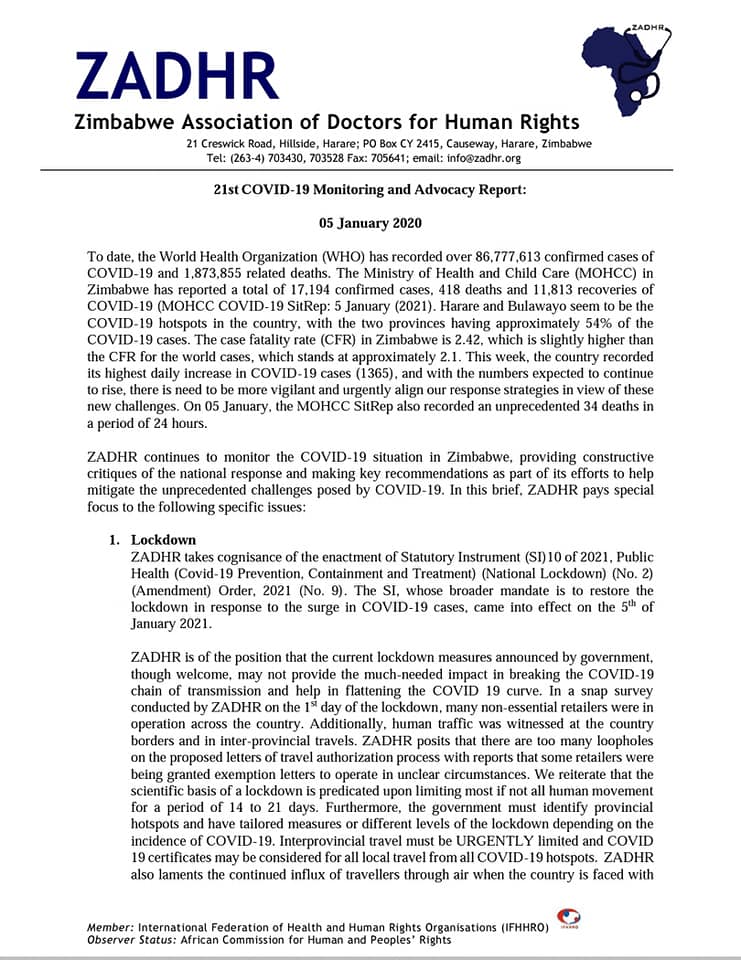
To date, the World Health Organization (WHO) has recorded over 86,777,613 confirmed cases of COVID-19 and 1,873,855 related deaths. The Ministry of Health and Child Care (MOHCC) in Zimbabwe has reported a total of 17,194 confirmed cases, 418 deaths and 11,813 recoveries of COVID-19 (MOHCC COVID-19 SitRep: 5 January (2021). Harare and Bulawayo seem to be the COVID-19 hotspots in the country, with the two provinces having approximately 54% of the COVID-19 cases. The case fatality rate (CFR) in Zimbabwe is 2.42, which is slightly higher than the CFR for the world cases, which stands at approximately 2.1. This week, the country recorded its highest daily increase in COVID-19 cases (1365), and with the numbers expected to continue to rise, there is need to be more vigilant and urgently align our response strategies in view of these new challenges. On 05 January, the MOHCC SitRep also recorded an unprecedented 34 deaths in a period of 24 hours.
ZADHR continues to monitor the COVID-19 situation in Zimbabwe, providing constructive critiques of the national response and making key recommendations as part of its efforts to help mitigate the unprecedented challenges posed by COVID-19. In this brief, ZADHR pays special focus to the following specific issues:
- Lockdown
ZADHR takes cognisance of the enactment of Statutory Instrument (SI)10 of 2021, Public Health (Covid-19 Prevention, Containment and Treatment) (National Lockdown) (No. 2) (Amendment) Order, 2021 (No. 9). The SI, whose broader mandate is to restore the lockdown in response to the surge in COVID-19 cases, came into effect on the 5th of January 2021.
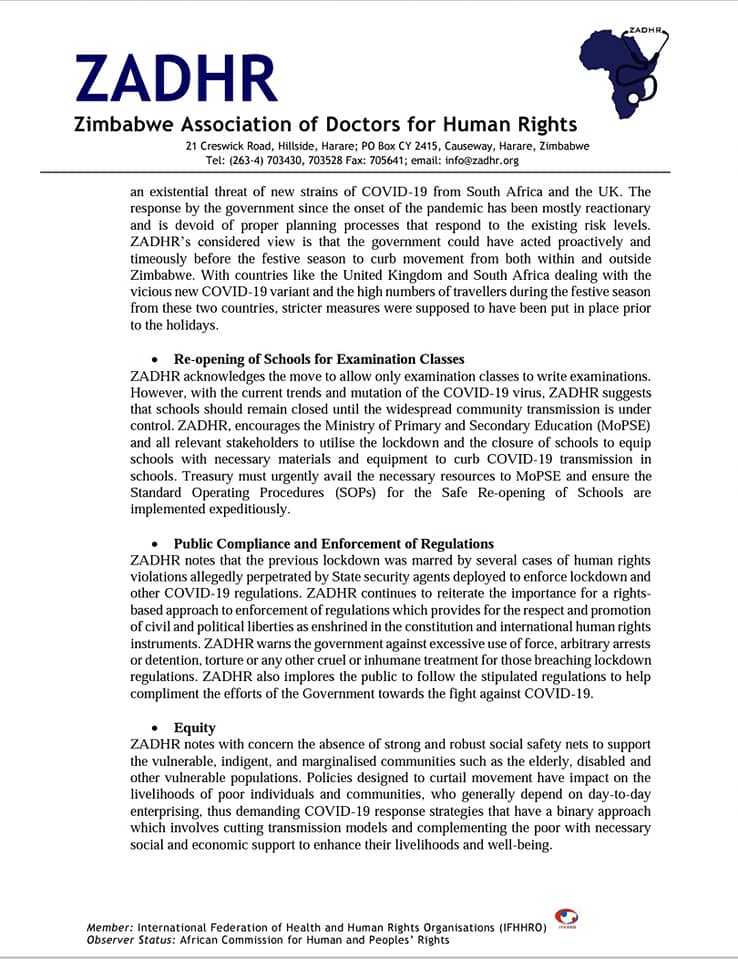
ZADHR is of the position that the current lockdown measures announced by government, though welcome, may not provide the much-needed impact in breaking the COVID-19 chain of transmission and help in flattening the COVID 19 curve. In a snap survey conducted by ZADHR on the 1st day of the lockdown, many non-essential retailers were in operation across the country. Additionally, human traffic was witnessed at the country borders and in inter-provincial travels. ZADHR posits that there are too many loopholes on the proposed letters of travel authorization process with reports that some retailers were being granted exemption letters to operate in unclear circumstances. We reiterate that the scientific basis of a lockdown is predicated upon limiting most if not all human movement for a period of 14 to 21 days. Furthermore, the government must identify provincial hotspots and have tailored measures or different levels of the lockdown depending on the incidence of COVID-19. Interprovincial travel must be URGENTLY limited and COVID 19 certificates may be considered for all local travel from all COVID-19 hotspots. ZADHR also laments the continued influx of travellers through air when the country is faced with an existential threat of new strains of COVID-19 from South Africa and the UK. The response by the government since the onset of the pandemic has been mostly reactionary and is devoid of proper planning processes that respond to the existing risk levels. ZADHR’s considered view is that the government could have acted proactively and timeously before the festive season to curb movement from both within and outside Zimbabwe. With countries like the United Kingdom and South Africa dealing with the vicious new COVID-19 variant and the high numbers of travellers during the festive season from these two countries, stricter measures were supposed to have been put in place prior to the holidays.
- Re-opening of Schools for Examination Classes
ZADHR acknowledges the move to allow only examination classes to write examinations. However, with the current trends and mutation of the COVID-19 virus, ZADHR suggests that schools should remain closed until the widespread community transmission is under control. ZADHR, encourages the Ministry of Primary and Secondary Education (MoPSE) and all relevant stakeholders to utilise the lockdown and the closure of schools to equip schools with necessary materials and equipment to curb COVID-19 transmission in schools. Treasury must urgently avail the necessary resources to MoPSE and ensure the Standard Operating Procedures (SOPs) for the Safe Re-opening of Schools are implemented expeditiously.
- Public Compliance and Enforcement of Regulations
ZADHR notes that the previous lockdown was marred by several cases of human rights violations allegedly perpetrated by State security agents deployed to enforce lockdown and other COVID-19 regulations. ZADHR continues to reiterate the importance for a rights-based approach to enforcement of regulations which provides for the respect and promotion of civil and political liberties as enshrined in the constitution and international human rights instruments. ZADHR warns the government against excessive use of force, arbitrary arrests or detention, torture or any other cruel or inhumane treatment for those breaching lockdown regulations. ZADHR also implores the public to follow the stipulated regulations to help compliment the efforts of the Government towards the fight against COVID-19.
- Equity
ZADHR notes with concern the absence of strong and robust social safety nets to support the vulnerable, indigent, and marginalised communities such as the elderly, disabled and other vulnerable populations. Policies designed to curtail movement have impact on the livelihoods of poor individuals and communities, who generally depend on day-to-day enterprising, thus demanding COVID-19 response strategies that have a binary approach which involves cutting transmission models and complementing the poor with necessary social and economic support to enhance their livelihoods and well-being.
- Provision of PPE
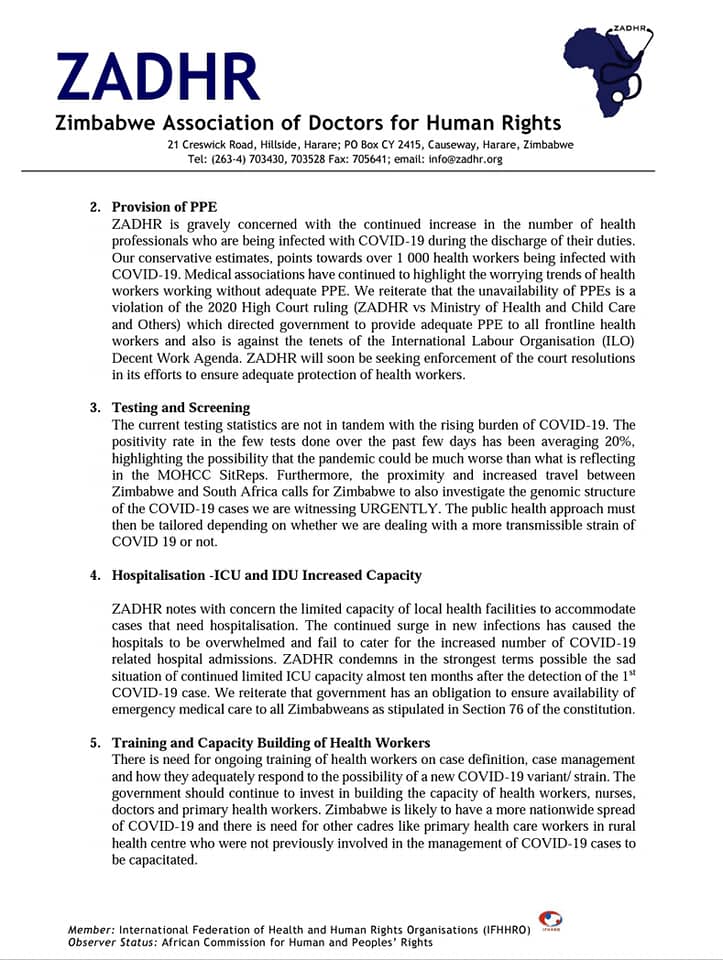
ZADHR is gravely concerned with the continued increase in the number of health professionals who are being infected with COVID-19 during the discharge of their duties. Our conservative estimates, points towards over 1 000 health workers being infected with COVID-19. Medical associations have continued to highlight the worrying trends of health workers working without adequate PPE. We reiterate that the unavailability of PPEs is a violation of the 2020 High Court ruling (ZADHR vs Ministry of Health and Child Care and Others) which directed government to provide adequate PPE to all frontline health workers and also is against the tenets of the International Labour Organisation (ILO) Decent Work Agenda. ZADHR will soon be seeking enforcement of the court resolutions in its efforts to ensure adequate protection of health workers.
- Testing and Screening
The current testing statistics are not in tandem with the rising burden of COVID-19. The positivity rate in the few tests done over the past few days has been averaging 20%, highlighting the possibility that the pandemic could be much worse than what is reflecting in the MOHCC SitReps. Furthermore, the proximity and increased travel between Zimbabwe and South Africa calls for Zimbabwe to also investigate the genomic structure of the COVID-19 cases we are witnessing URGENTLY. The public health approach must then be tailored depending on whether we are dealing with a more transmissible strain of COVID 19 or not.
- Hospitalisation -ICU and IDU Increased Capacity
ZADHR notes with concern the limited capacity of local health facilities to accommodate cases that need hospitalisation. The continued surge in new infections has caused the hospitals to be overwhelmed and fail to cater for the increased number of COVID-19 related hospital admissions. ZADHR condemns in the strongest terms possible the sad situation of continued limited ICU capacity almost ten months after the detection of the 1st COVID-19 case. We reiterate that government has an obligation to ensure availability of emergency medical care to all Zimbabweans as stipulated in Section 76 of the constitution.
- Training and Capacity Building of Health Workers
There is need for ongoing training of health workers on case definition, case management and how they adequately respond to the possibility of a new COVID-19 variant/ strain. The government should continue to invest in building the capacity of health workers, nurses, doctors and primary health workers. Zimbabwe is likely to have a more nationwide spread of COVID-19 and there is need for other cadres like primary health care workers in rural health centre who were not previously involved in the management of COVID-19 cases to be capacitated.
- COVID-19 Vaccine
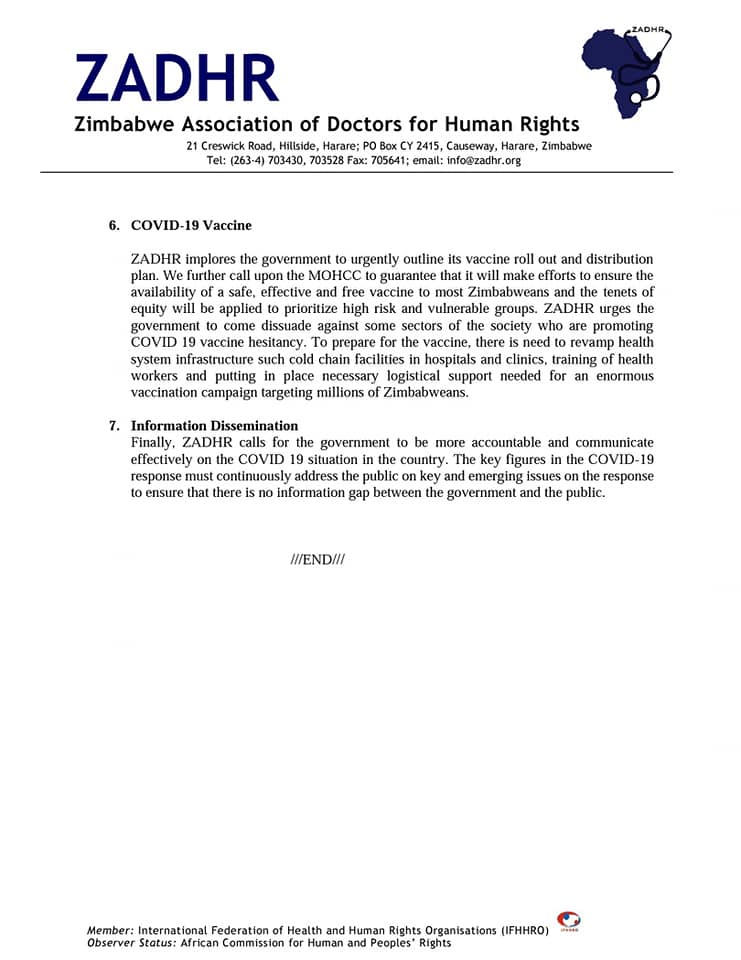
ZADHR implores the government to urgently outline its vaccine roll out and distribution plan. We further call upon the MOHCC to guarantee that it will make efforts to ensure the availability of a safe, effective and free vaccine to most Zimbabweans and the tenets of equity will be applied to prioritize high risk and vulnerable groups. ZADHR urges the government to come dissuade against some sectors of the society who are promoting COVID 19 vaccine hesitancy. To prepare for the vaccine, there is need to revamp health system infrastructure such cold chain facilities in hospitals and clinics, training of health workers and putting in place necessary logistical support needed for an enormous vaccination campaign targeting millions of Zimbabweans.
- Information Dissemination
Finally, ZADHR calls for the government to be more accountable and communicate effectively on the COVID 19 situation in the country. The key figures in the COVID-19 response must continuously address the public on key and emerging issues on the response to ensure that there is no information gap between the government and the public.
21stCOVID-19 Monitoring and Advocacy Report:
05 January 2020
To date, the World Health Organization (WHO) has recorded over 86,777,613 confirmed cases of COVID-19 and 1,873,855 related deaths. The Ministry of Health and Child Care (MOHCC) in Zimbabwe has reported a total of 17,194 confirmed cases, 418 deaths and 11,813 recoveries of COVID-19 (MOHCC COVID-19 SitRep: 5 January (2021). Harare and Bulawayo seem to be the COVID-19 hotspots in the country, with the two provinces having approximately 54% of the COVID-19 cases. The case fatality rate (CFR) in Zimbabwe is 2.42, which is slightly higher than the CFR for the world cases, which stands at approximately 2.1. This week, the country recorded its highest daily increase in COVID-19 cases (1365), and with the numbers expected to continue to rise, there is need to be more vigilant and urgently align our response strategies in view of these new challenges. On 05 January, the MOHCC SitRep also recorded an unprecedented 34 deaths in a period of 24 hours.
ZADHR continues to monitor the COVID-19 situation in Zimbabwe, providing constructive critiques of the national response and making key recommendations as part of its efforts to help mitigate the unprecedented challenges posed by COVID-19. In this brief, ZADHR pays special focus to the following specific issues:
- Lockdown
ZADHR takes cognisance of the enactment of Statutory Instrument (SI)10 of 2021, Public Health (Covid-19 Prevention, Containment and Treatment) (National Lockdown) (No. 2) (Amendment) Order, 2021 (No. 9). The SI, whose broader mandate is to restore the lockdown in response to the surge in COVID-19 cases, came into effect on the 5th of January 2021.
ZADHR is of the position that the current lockdown measures announced by government, though welcome, may not provide the much-needed impact in breaking the COVID-19 chain of transmission and help in flattening the COVID 19 curve. In a snap survey conducted by ZADHR on the 1st day of the lockdown, many non-essential retailers were in operation across the country. Additionally, human traffic was witnessed at the country borders and in inter-provincial travels. ZADHR posits that there are too many loopholes on the proposed letters of travel authorization process with reports that some retailers were being granted exemption letters to operate in unclear circumstances. We reiterate that the scientific basis of a lockdown is predicated upon limiting most if not all human movement for a period of 14 to 21 days. Furthermore, the government must identify provincial hotspots and have tailored measures or different levels of the lockdown depending on the incidence of COVID-19. Interprovincial travel must be URGENTLY limited and COVID 19 certificates may be considered for all local travel from all COVID-19 hotspots. ZADHR also laments the continued influx of travellers through air when the country is faced with an existential threat of new strains of COVID-19 from South Africa and the UK. The response by the government since the onset of the pandemic has been mostly reactionary and is devoid of proper planning processes that respond to the existing risk levels. ZADHR’s considered view is that the government could have acted proactively and timeously before the festive season to curb movement from both within and outside Zimbabwe. With countries like the United Kingdom and South Africa dealing with the vicious new COVID-19 variant and the high numbers of travellers during the festive season from these two countries, stricter measures were supposed to have been put in place prior to the holidays.
- Re-opening of Schools for Examination Classes
ZADHR acknowledges the move to allow only examination classes to write examinations. However, with the current trends and mutation of the COVID-19 virus, ZADHR suggests that schools should remain closed until the widespread community transmission is under control. ZADHR, encourages the Ministry of Primary and Secondary Education (MoPSE) and all relevant stakeholders to utilise the lockdown and the closure of schools to equip schools with necessary materials and equipment to curb COVID-19 transmission in schools. Treasury must urgently avail the necessary resources to MoPSE and ensure the Standard Operating Procedures (SOPs) for the Safe Re-opening of Schools are implemented expeditiously.
- Public Compliance and Enforcement of Regulations
ZADHR notes that the previous lockdown was marred by several cases of human rights violations allegedly perpetrated by State security agents deployed to enforce lockdown and other COVID-19 regulations. ZADHR continues to reiterate the importance for a rights-based approach to enforcement of regulations which provides for the respect and promotion of civil and political liberties as enshrined in the constitution and international human rights instruments. ZADHR warns the government against excessive use of force, arbitrary arrests or detention, torture or any other cruel or inhumane treatment for those breaching lockdown regulations. ZADHR also implores the public to follow the stipulated regulations to help compliment the efforts of the Government towards the fight against COVID-19.
- Equity
ZADHR notes with concern the absence of strong and robust social safety nets to support the vulnerable, indigent, and marginalised communities such as the elderly, disabled and other vulnerable populations. Policies designed to curtail movement have impact on the livelihoods of poor individuals and communities, who generally depend on day-to-day enterprising, thus demanding COVID-19 response strategies that have a binary approach which involves cutting transmission models and complementing the poor with necessary social and economic support to enhance their livelihoods and well-being.
- Provision of PPE
ZADHR is gravely concerned with the continued increase in the number of health professionals who are being infected with COVID-19 during the discharge of their duties. Our conservative estimates, points towards over 1 000 health workers being infected with COVID-19. Medical associations have continued to highlight the worrying trends of health workers working without adequate PPE. We reiterate that the unavailability of PPEs is a violation of the 2020 High Court ruling (ZADHR vs Ministry of Health and Child Care and Others) which directed government to provide adequate PPE to all frontline health workers and also is against the tenets of the International Labour Organisation (ILO) Decent Work Agenda. ZADHR will soon be seeking enforcement of the court resolutions in its efforts to ensure adequate protection of health workers.
- Testing and Screening
The current testing statistics are not in tandem with the rising burden of COVID-19. The positivity rate in the few tests done over the past few days has been averaging 20%, highlighting the possibility that the pandemic could be much worse than what is reflecting in the MOHCC SitReps. Furthermore, the proximity and increased travel between Zimbabwe and South Africa calls for Zimbabwe to also investigate the genomic structure of the COVID-19 cases we are witnessing URGENTLY. The public health approach must then be tailored depending on whether we are dealing with a more transmissible strain of COVID 19 or not.
- Hospitalisation -ICU and IDU Increased Capacity
ZADHR notes with concern the limited capacity of local health facilities to accommodate cases that need hospitalisation. The continued surge in new infections has caused the hospitals to be overwhelmed and fail to cater for the increased number of COVID-19 related hospital admissions. ZADHR condemns in the strongest terms possible the sad situation of continued limited ICU capacity almost ten months after the detection of the 1st COVID-19 case. We reiterate that government has an obligation to ensure availability of emergency medical care to all Zimbabweans as stipulated in Section 76 of the constitution.
- Training and Capacity Building of Health Workers
There is need for ongoing training of health workers on case definition, case management and how they adequately respond to the possibility of a new COVID-19 variant/ strain. The government should continue to invest in building the capacity of health workers, nurses, doctors and primary health workers. Zimbabwe is likely to have a more nationwide spread of COVID-19 and there is need for other cadres like primary health care workers in rural health centre who were not previously involved in the management of COVID-19 cases to be capacitated.
- COVID-19 Vaccine
ZADHR implores the government to urgently outline its vaccine roll out and distribution plan. We further call upon the MOHCC to guarantee that it will make efforts to ensure the availability of a safe, effective and free vaccine to most Zimbabweans and the tenets of equity will be applied to prioritize high risk and vulnerable groups. ZADHR urges the government to come dissuade against some sectors of the society who are promoting COVID 19 vaccine hesitancy. To prepare for the vaccine, there is need to revamp health system infrastructure such cold chain facilities in hospitals and clinics, training of health workers and putting in place necessary logistical support needed for an enormous vaccination campaign targeting millions of Zimbabweans.
- Information Dissemination
Finally, ZADHR calls for the government to be more accountable and communicate effectively on the COVID 19 situation in the country. The key figures in the COVID-19 response must continuously address the public on key and emerging issues on the response to ensure that there is no information gap between the government and the public.
///END///